
Casement vs. Double-Hung Windows: Which Is Right for Your Dayton Home?
Casement vs. double-hung windows comes down to how you use each opening. A casement swings out on a side hinge with a crank, opens fully and tends to seal tightly when locked. A double-hung has two sashes that slide up and down, fits the look of most older Dayton houses, and usually costs a little less. Neither is better everywhere. Most Miami Valley homes end up with mostly double-hung windows and a few casements where they solve a specific problem.
How each window works
Double-hung: both the top and bottom sash slide in the frame on balances. Most current models tilt in so you can clean the outside glass from indoors. The screen sits on the outside.
Casement: one sash hinged on the side, opened with a crank. When it closes, the sash pulls against the weatherstripping on all four sides. The screen sits on the inside, since the sash swings outward.
Casement vs. double-hung windows at a glance
| Casement | Double-hung | |
|---|---|---|
| How it opens | Crank swings sash outward | Sashes slide up and down |
| Open area | Nearly the full sash | About half the window at most |
| Air sealing | Sash presses into weatherstrip when locked; tends to seal tighter | Sliding seals between sashes; good when new, can loosen with wear |
| Hard-to-reach spots | Easy to crank open over a sink or counter | Lifting a sash over a counter is awkward |
| Cleaning | Outside glass reachable when cranked open | Tilt-in sashes on most models |
| Window AC unit | Not practical | Works |
| Next to walkways and decks | Open sash can swing into the path | Stays in the wall plane |
| Look on older homes | More modern; changes the facade | Matches most pre-1960 houses |
| Typical published range (unit) | $400–$1,200 | $300–$1,000 |
Which is more energy efficient in a Dayton winter?
Dayton is in IECC Climate Zone 5A, with about 5,149 heating degree days and roughly 110 freezing nights a year (NOAA 1991–2020 normals). In that climate, air leakage and glass performance both matter.
Casements have an edge on air leakage because the sash clamps against its seals. Double-hung windows rely on sliding seals that can wear over the years. But the glass package usually matters more than the style. A well-built double-hung with good low-E glass can outperform a cheap casement. Compare the NFRC label on each quote, especially the U-factor (lower is better), and the air leakage rating if it's listed. Ohio falls largely in ENERGY STAR's Northern climate zone; check the label for the zone the window is certified for. The energy-efficient windows page explains the numbers.
Where casement windows make sense
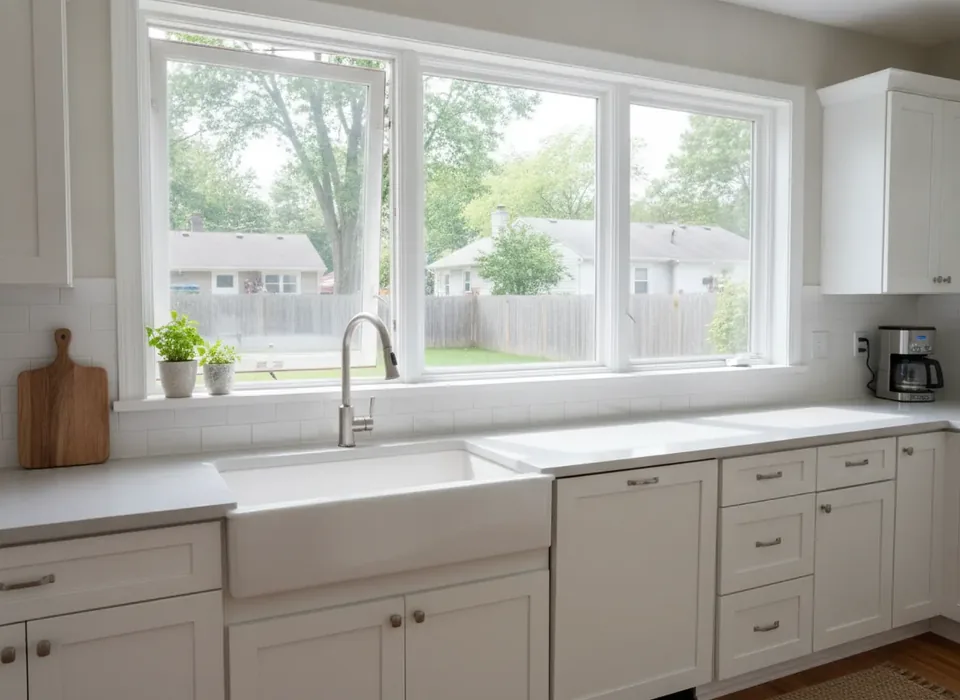
- Over the kitchen sink. A crank is much easier than lifting a sash across a counter.
- Tall, narrow openings where a double-hung would have very short sashes.
- Rooms that need airflow. An open casement sash can catch a side breeze and direct it inside.
- Basement or bedroom escape openings. Because a casement opens nearly fully, it can often meet egress size in a smaller opening than a double-hung. Confirm the clear opening with your installer; the egress and basement windows page covers the requirements.
Where double-hung windows make sense
- Traditional houses. The City of Dayton's median home was built in 1951, and Oakwood's in 1938 (Census ACS 2020–2024). Double-hung sashes are what most of those houses were built with.
- Openings onto porches, decks and walkways, where an outward-swinging sash would be in the way.
- Rooms that use a window air conditioner.
- Budget-sensitive whole-house jobs. Fixr's ranges put double-hung units slightly below casements.
See the double-hung windows and casement and sliding windows pages for how local installers handle each style.
Can you replace double-hung windows with casements?
Usually, yes, within the same rough opening. A wide double-hung opening may get two casements with a center mullion, or a casement paired with a fixed picture unit. A few points to settle first:
- Proportions. Very wide casement sashes are heavy on their hinges, so installers split wide openings.
- Egress. If the window is a bedroom's emergency escape opening, the new window must still provide the required clear opening. Ohio's residential code does not treat changing a required means of egress as a minor repair.
- Cost. A style change is often more work than a like-for-like swap, especially if it calls for a mullion or new interior trim. Get it priced per opening.
Historic district? A style change is a design change.
The City of Dayton has 13 locally designated historic districts. Replacement windows that match the existing design need a minor Certificate of Appropriateness from the Historic Preservation Officer; changing window openings goes to the Landmark Commission. Swapping double-hung sashes for casements may not count as matching the existing design, so ask before ordering. In Centerville's Architectural Preservation District, the Board of Architectural Review has approved replacement windows on the condition that they follow the existing grid pattern. More in replacing windows in a Dayton historic district.
Cost: casement vs. double-hung
By Fixr's published ranges (Jan 2026), a double-hung unit runs $300–$1,000 and a casement $400–$1,200, with standard installation labor of $150–$300 per window on top. The crank hardware and hinges are the main reason casements cost more. For a full budget across your house, including material choice and bay or bow windows, use the Dayton window replacement cost guide and its calculator.
Questions to ask installers
- Which openings would you make casements, and why?
- What are the U-factor and air leakage ratings for each style you're quoting?
- For bedrooms and basements, will the new window meet egress size?
- Is the casement hardware covered by the same warranty as the frame? Get the terms in writing.
- For a pre-1978 home, are you an EPA Lead-Safe Certified Firm?
Not sure which mix fits your house? Request free quotes and ask each independent installer to price both options for the openings you're unsure about.
Frequently asked questions
Are casement windows more energy efficient than double-hung windows?
Casements tend to leak less air because the sash presses into its weatherstripping when locked, while double-hung windows rely on sliding seals. The glass package usually matters more than the style, though. Compare the NFRC U-factor and air leakage ratings on each quote.
Which costs less, casement or double-hung?
Double-hung windows usually cost a little less. Fixr's published ranges (Jan 2026) are $300–$1,000 for a double-hung unit and $400–$1,200 for a casement, plus $150–$300 labor per standard window. Dayton installers' quotes vary with size, glass and install type.
Can I switch to casement windows in a Dayton historic district?
Possibly, but not automatically. Matching replacements need a minor Certificate of Appropriateness from the Historic Preservation Officer, and a style change may not count as matching the existing design. Ask the Historic Preservation Officer before you order.
Which style is better for a basement or bedroom egress window?
Casements often work well because they open nearly fully, so they can meet the required clear opening in a smaller window than a double-hung. The installer should confirm the net clear opening and sill height for your room, and changing an egress opening usually needs building approval.